
In the world of technological development, there is still a belief: that a product should not see the light until it is completely finished and "perfect." But the reality of business, and of users, teaches us otherwise. At EMAST, we believe in launching solutions that think like the user, and for that, there is no better path than that of MVPs (Minimum Viable Product).
The myth of the "finished product"
Many clients fear going to market with an "incomplete" product, out of fear of user judgment, error, or supposed reputational risk. But in technology, waiting for everything to be ready can be more costly than going out early and learning quickly. Because the perfect product simply does not exist: there will always be something to improve, adjust, or rethink.
Agility or speed? They are not the same
This is a point where many organizations get confused: speed seeks to deliver in the shortest time possible, often sacrificing analysis, strategy, or validation. It runs, but does not always know where to. Agility, on the other hand, involves progressing in short cycles, constantly validating with the user, adjusting the solution based on real evidence, and maximizing the value delivered in each iteration, because it is not about going faster, but about going in the right direction.
An agile team does not improvise, it prioritizes. It does not accelerate under pressure, but advances with focus. At EMAST, we apply this by creating products that evolve in a controlled manner, without waiting for the perfect moment, but without leaving anything to chance.
What happens when an agile approach is not applied?
When working without an agile mindset, the chances of failure increase significantly. The most common mistakes include:
- Poorly defined requirements from the start, which do not respond to the real needs of the user.
- Constant changes without a structure to manage them, leading to chaos and costly rework.
- Lack of active participation from the client, which disconnects the business from the final product.
- Misaligned expectations between business and technology, resulting in products that do not solve the original problem.
In these cases, teams develop for months without validation, and in the end, they face a product that no one wants or that arrives late to the market.
The real value of the MVP
An MVP is not a half-finished product. It is a functional solution, with the minimum necessary to validate hypotheses, listen to the user, and generate real learning from practice. It is a strategic starting point, not an improvised prototype.
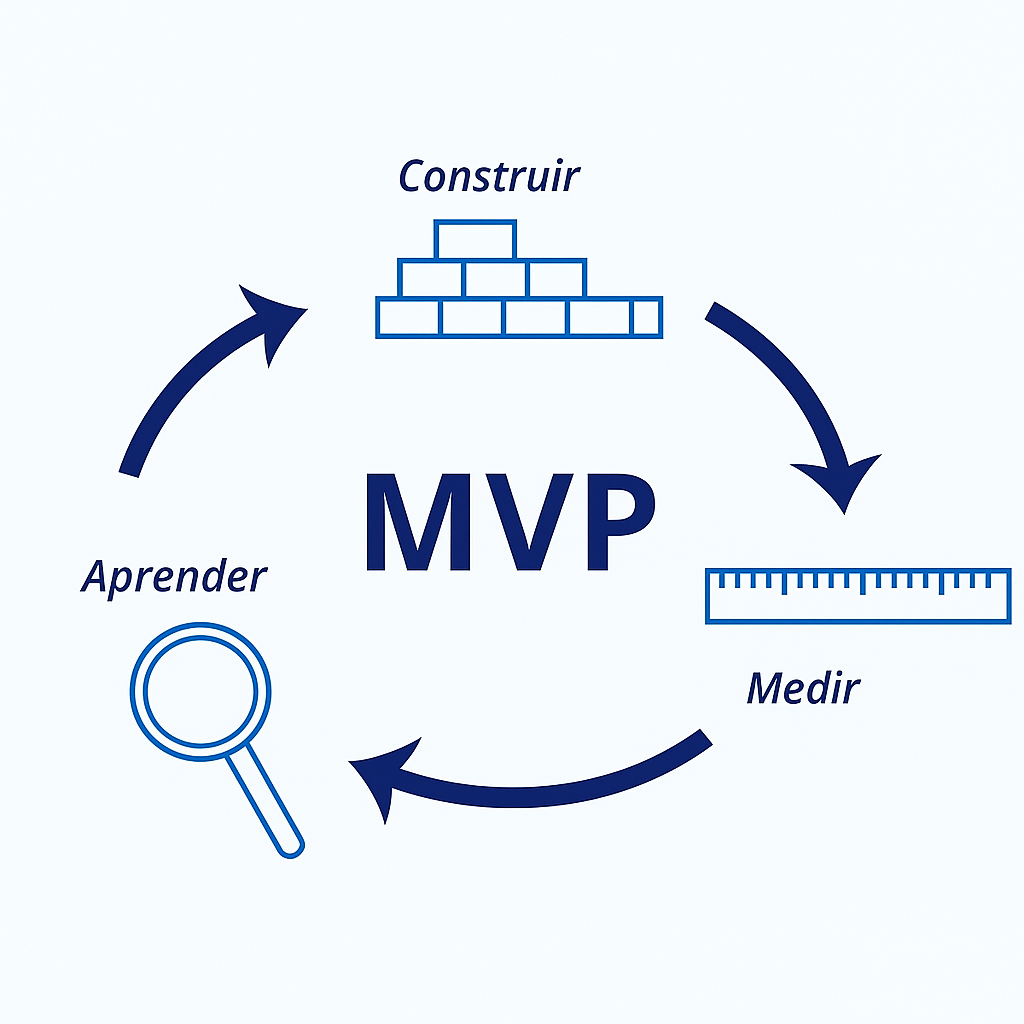
Implementing an MVP allows:
- To validate if the problem we are solving really matters to the user.
- To save resources by avoiding the development of features that are not used.
- To iterate and improve based on real data, not assumptions.
Real cases: what we have learned with our clients
In our automation processes, custom development, and technology consulting, we have seen time and again how clients who dare to launch with an MVP achieve:
- Better adoption by the team.
- Greater clarity on the true bottlenecks of the business.
- Tangible results in less time.
Those who wait to have "everything ready" often take longer, spend more, and continue guessing what their user wants.
Conclusion: moving with agility is moving with intelligence
Agility is not just a methodology, it is a mindset. It means assuming that we do not have all the answers from the start, but that we can build them step by step, in collaboration with our users and with a focus on what is essential.
At EMAST, we believe that the true value of technology is not in what it promises, but in what it delivers from the first version. That is why we design custom products, with a business vision, continuous iteration, and a real commitment to the outcome.